
As CRNAs, we are trained to evaluate risk. We read the numbers, look for patterns, and prepare for different outcomes before making consequential decisions. Investing should be no different.
When I study multifamily real estate today, I see several forces moving at once: a construction boom that is subsiding, apartment demand that is absorbing new units, expensive financing that makes new development harder, and a homeownership market that keeps many households renting longer.
That combination deserves attention. Let's walk through what the data actually says.
1. The wave of new apartments is being absorbed
Developers responded to low borrowing costs and strong rental demand by starting a large number of projects earlier in the decade. Because buildings take years to complete, many of those projects arrived just as interest rates were rising. The resulting supply surge put pressure on rents and leasing incentives.
Now the balance is shifting. Through the first nine months of 2026, U.S. apartment net absorption, the increase in the number of occupied units, was approximately 350,000 units, versus approximately 250,000 newly delivered units. Deliveries were down about 25% year over year, according to Cushman & Wakefield's Q3 2026 research.
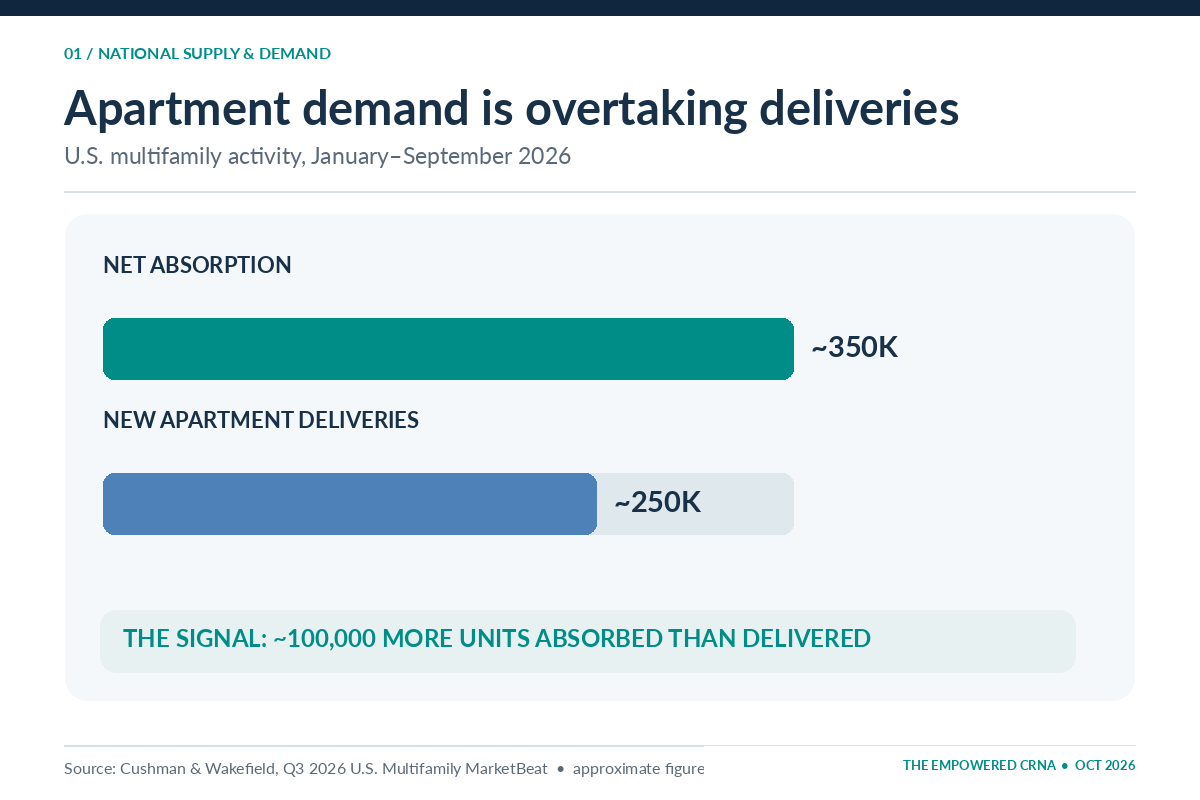
What this means: Fewer new units are arriving while the number of occupied apartments is still growing. That can gradually reduce vacant supply, though rent growth will vary by city.
2. The picture differs dramatically by metro
This is where I think an investor's analytical mindset becomes especially valuable. Two cities can both be "growing," but one may be absorbing new apartments faster than builders finish them while another is still working through an oversupply.
Consider four markets we follow. Over the trailing four quarters ending Q3 2026, the following figures were reported by MMG Real Estate Advisors:
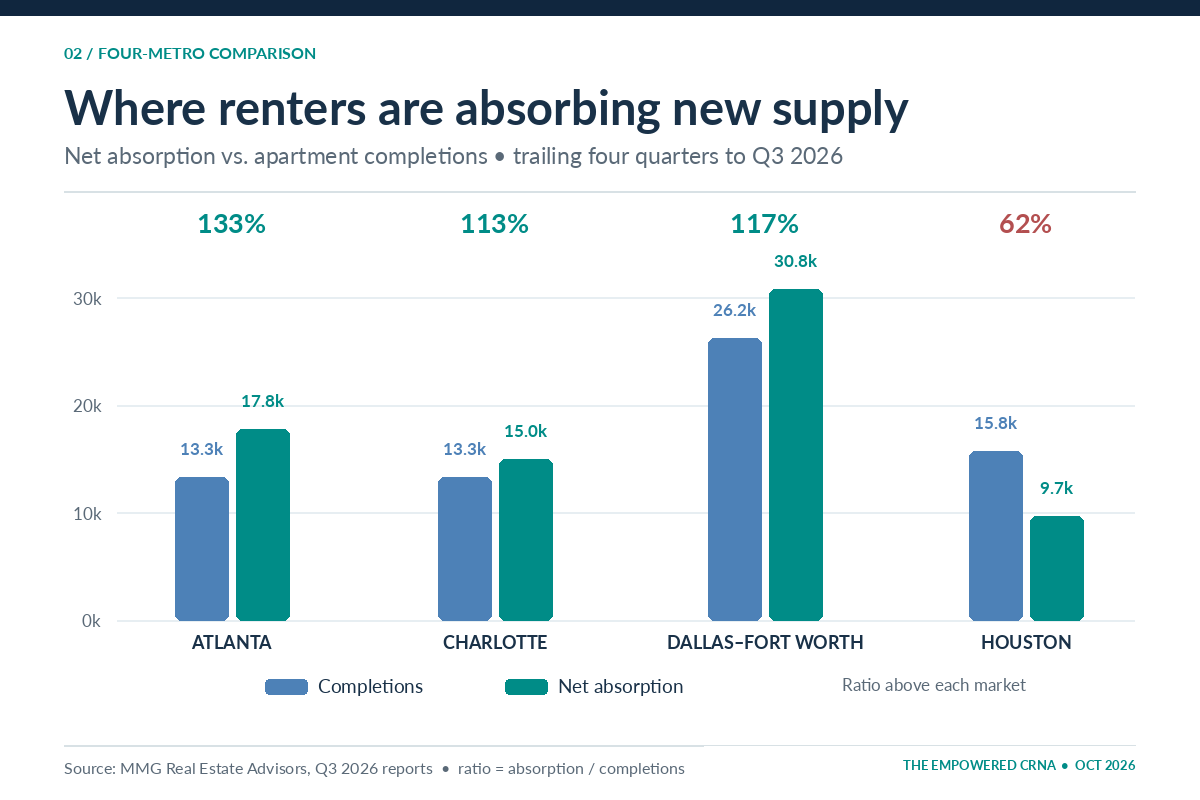
- Atlanta: 133%. 17,784 absorbed / 13,327 completed
- Charlotte: 113%. 14,992 absorbed / 13,302 completed
- Dallas-Fort Worth: 117%. 30,789 absorbed / 26,236 completed
- Houston: 62%. 9,704 absorbed / 15,766 completed
Atlanta, Charlotte, and Dallas-Fort Worth recorded net absorption greater than completions. Houston still recorded significantly more completions than net absorption. That contrast helps explain why location, timing, and submarket selection matter so much.
Here's the important counterpoint: all four markets had negative annual rent growth in this dataset. The direction of supply and demand can improve before landlords regain pricing power.
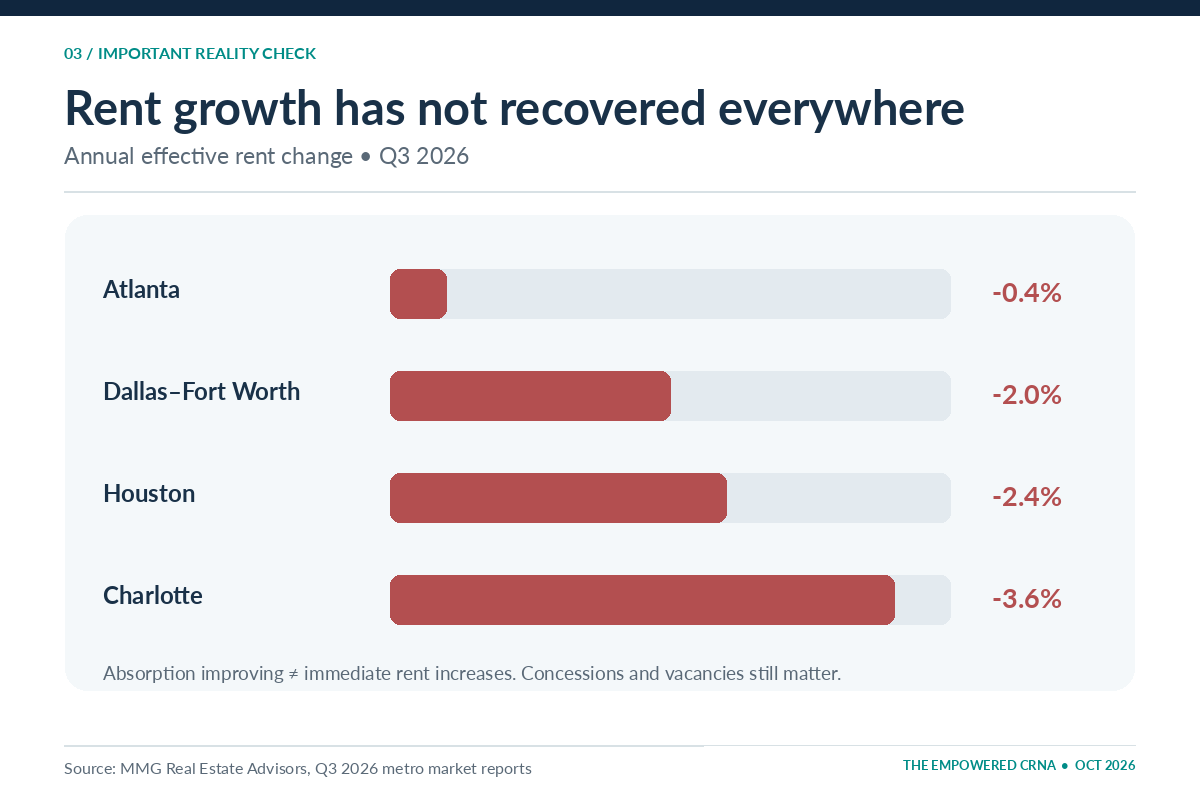
The market figures above are from the Q3 2026 reports for Atlanta, Charlotte, Dallas-Fort Worth, and Houston. Providers report different numbers based on coverage and methodology, so compare figures within one series.
3. Construction slows today, and future supply may tighten later
Developers do not build apartments overnight. When financing is expensive and construction costs remain elevated, some projects become harder to justify. That can reduce starts today and deliveries later.
In September 2026, multifamily housing starts were running at an annualized pace of about 362,000 units, down 24.9% year over year, according to the National Association of Home Builders. Separately, Cushman & Wakefield reported fewer than 480,000 units under construction nationally at Q3's end, the lowest nominal pipeline since 2015.
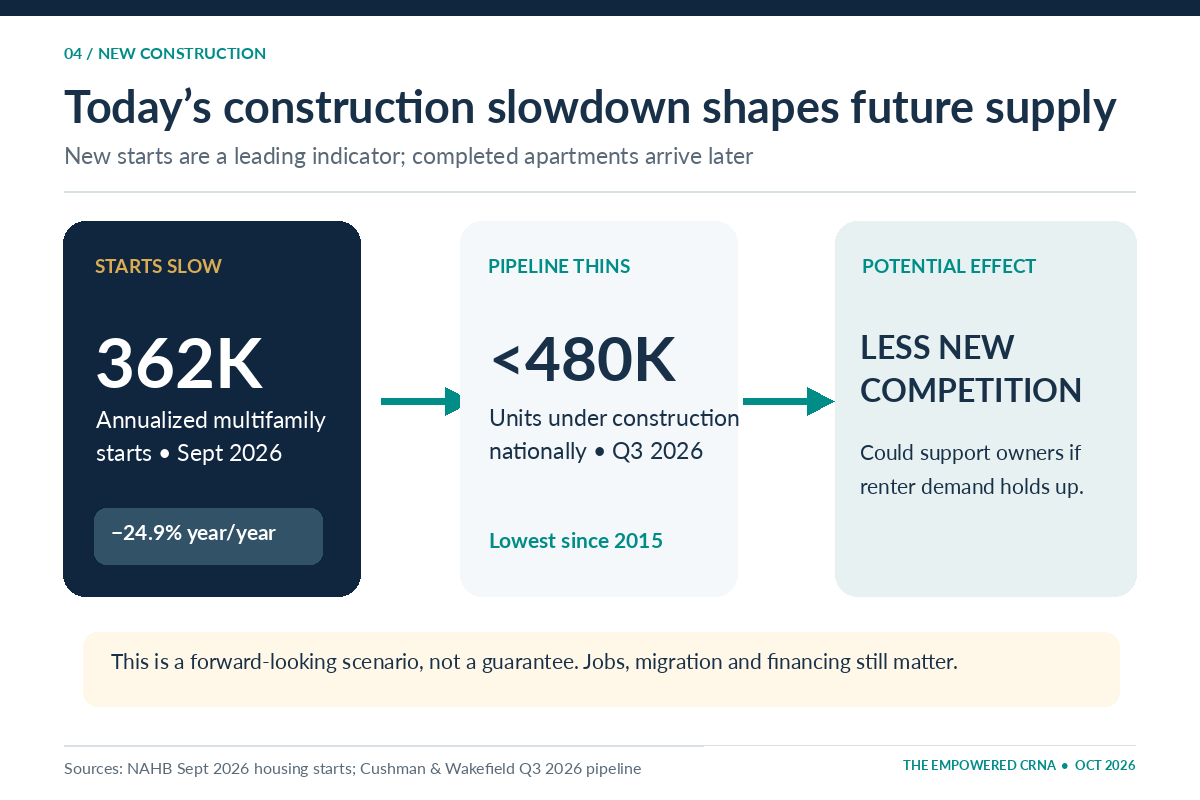
The possible result? If renters continue forming households while fewer apartments arrive, owners of well-located existing communities may face less new competition. A weakening job market could undermine that thesis, and high rates can strain existing apartment debt.
4. Expensive homeownership can extend the renting years
A rising salary does not automatically make buying a home the most practical decision. Mortgage rates, property taxes, insurance, and home prices all shape the monthly payment. As of October 29, 2026, the average 30-year fixed mortgage rate was 7.24%, according to Freddie Mac.
In its 2026 outlook, CBRE estimated a 105% monthly cost premium to buy versus rent in the United States. In simple indexed terms, if renting costs 100, the estimated comparable cost of buying is 205. That is a national estimate.
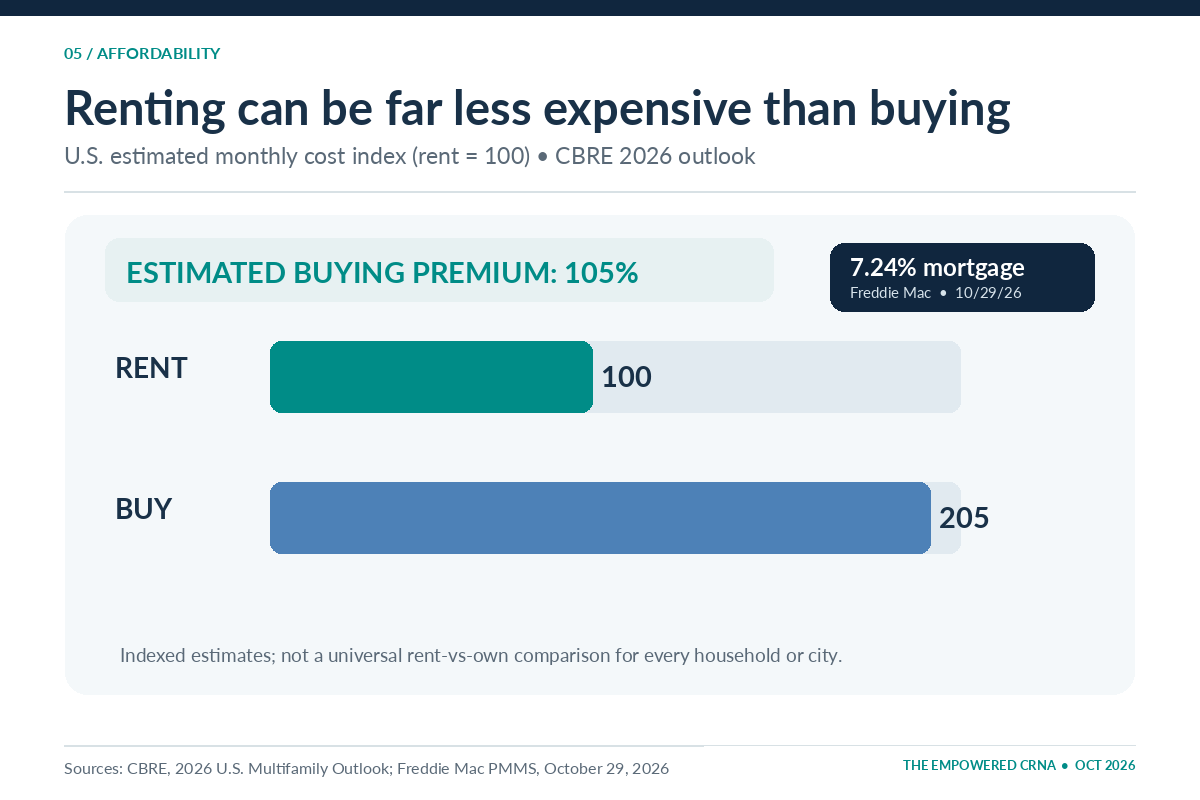
This can keep some would-be buyers in the rental market longer, contributing to apartment demand. It's one more reason to study rental housing, alongside local wages, affordability, and inventory.
5. Bonus depreciation is back. Understand its limits.
For high-income CRNAs, real estate taxation is part of the education. Current federal law restored a permanent 100% bonus depreciation deduction for certain qualifying assets acquired after January 19, 2025, subject to detailed eligibility and placed-in-service rules. A cost segregation study may identify eligible components of a rental property that can be depreciated faster. See the IRS guidance.
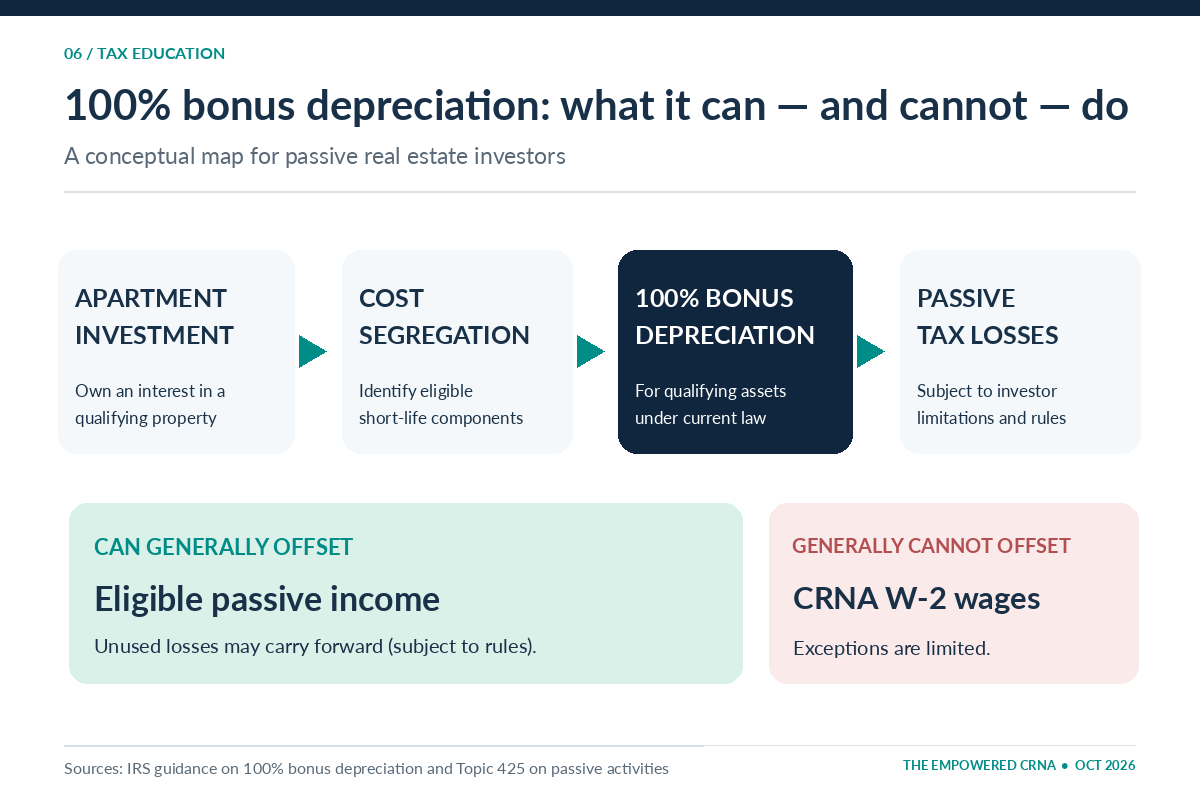
Crucial distinction: For a typical passive syndication investor, passive losses generally offset qualifying passive income, not W-2 anesthesia wages. Disallowed passive losses may carry forward subject to the rules, while basis, at-risk limits, and eventual property sales can affect the final result. The IRS explains these passive activity limitations in more detail.
So the opportunity is not "invest now and erase your W-2 taxes." It's to understand how real estate can fit into a longer-term strategy for building assets, managing taxable passive income, and planning future liquidity events with a qualified tax advisor.
6. Turning strong income into long-term ownership
As clinicians, most of us generate substantial income because we show up and use a specialized skill. There is nothing wrong with that. But if our long-term goal is financial choice, we also need to consider assets capable of creating value beyond our working hours.
An apartment syndication pools investor capital to own and operate multifamily properties. The sponsor or operating team typically handles financing, the business plan, and oversight of management. Investors may participate in potential cash flow, principal paydown, and appreciation.
I believe the right question for a CRNA is not simply, "Could I earn a return here?" It is, "Does this fit my time horizon, liquidity needs, portfolio, and appetite for risk?"
7. Putting the thesis to work: Montrose Berkeley Lake
At XSITE Capital, we're currently raising capital for Montrose Berkeley Lake, an apartment community in Duluth in the Atlanta metropolitan area. The public property listing describes a community of 492 units built in 1986. We see the broader Atlanta market's improving absorption as a reason to look closely there. Each property still has to earn it on its own numbers.
For a property such as Montrose, the market narrative must give way to actual underwriting: purchase price, existing occupancy, collections, maintenance needs, debt service, financing maturity, reserves, comparable rents, competitive new construction nearby, and conservative exit assumptions.
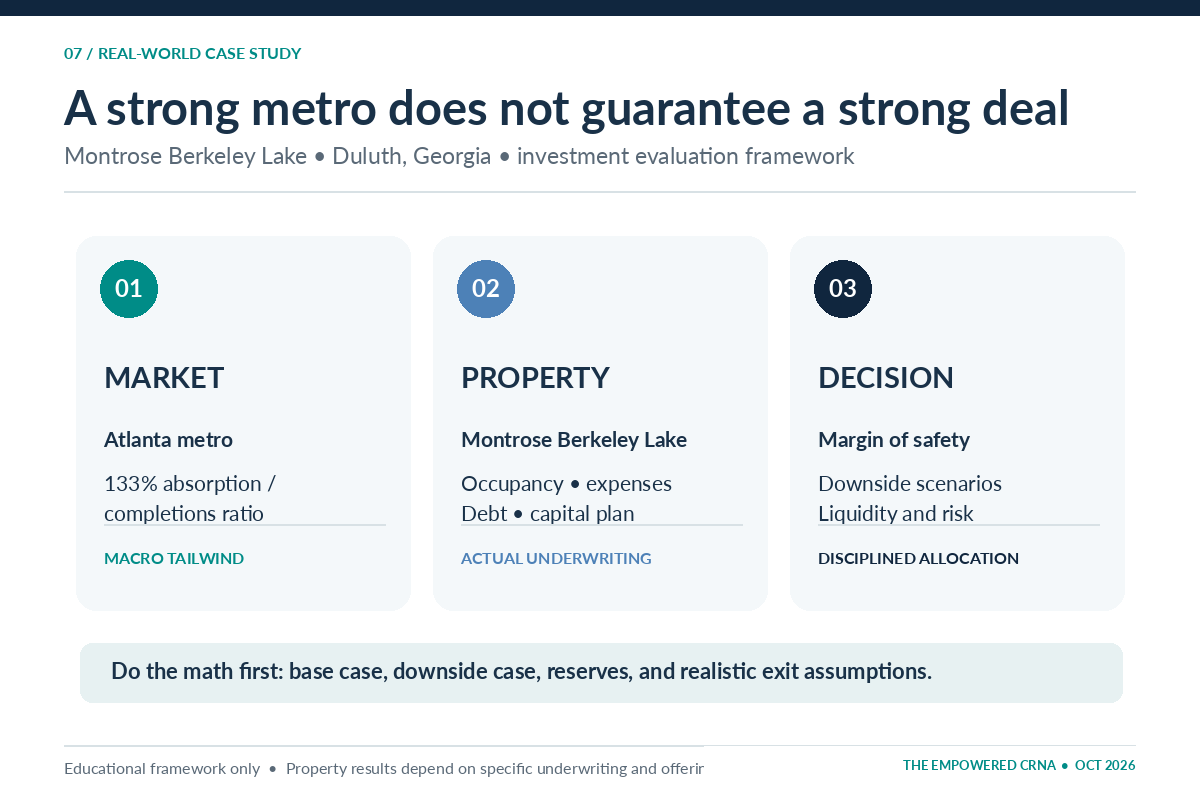
Metro-wide statistics are only a starting point. Supply can be concentrated in a particular Atlanta suburb even while the overall metro pipeline declines. That is why the immediate Duluth/Berkeley Lake competitive set needs its own analysis.
Investment in Montrose is open only to verified accredited investors. If that's you, the offering materials and a call with me are where we go through every assumption.
8. Opportunity comes from preparation, not prediction
No one can tell us exactly when the multifamily market will bottom, when borrowing costs will ease, or when a given property's rents will recover. What we can do is recognize that cycles create changing conditions, and study where those conditions may eventually reward patient, disciplined capital.
The data suggests a meaningful shift: deliveries are slowing, many renters are absorbing prior supply, and development faces new economic constraints. It also reminds us that some cities are still dealing with weak rents and excess supply. Both truths belong in a sound investment decision.
Our anesthesia income can create tremendous opportunities. What we do with that income can shape our long-term financial freedom.
For me, the goal is not to convince CRNAs to leave anesthesia. It's to help us build enough financial strength that practicing anesthesia can become a choice rather than a necessity.
Educational material only. Not investment, legal, or tax advice. Consult qualified advisors. Private placements are illiquid and involve risk, including possible loss of principal. Past performance does not guarantee future results. This is not an offer to sell or a solicitation of an offer to buy securities; any offer is made only through the offering documents to verified accredited investors. Reported market figures are estimates that vary by provider, coverage, and methodology. The strategy call is an educational discussion, not individualized investment, legal, or tax advice. CRNA and SRNA eligibility for a call does not establish eligibility for any private securities offering.